

One Hour From Baku, Ten Thousand Years Back in Time
Most tourists spend their first days in Baku without realizing that one of the most extraordinary archaeological sites on the planet sits just 60 kilometers south of the city center.
Gobustan National Park is not a reconstruction. It is not a theme park or a heritage trail with explanatory signs every few meters. It is the actual place where some of the earliest human beings on this land lived, hunted, danced, made music, and recorded their existence by carving images into stone — images that are still there, still visible, still carrying the energy of whoever made them thousands of years ago.
At Luxline, we have brought travelers from across the world to Gobustan. Historians, families, backpackers, corporate groups. The reaction is remarkably consistent: people go quiet when they get there. Not from boredom — from the weight of what they are standing in front of.
This guide will tell you everything you need to know to make the most of your visit.
Getting There: Easy, Fast, and Comfortable
Distance from Baku: 60 kilometers Driving time: Approximately 1 hour Road condition: Excellent — highway the entire way
The drive from Baku to Gobustan is one of the easiest day trip routes in Azerbaijan. The road is smooth, well-maintained highway, and the journey is relaxed and straightforward. No mountain passes, no rough terrain, no navigation challenges. You leave the city, drive south along the Caspian coastline, and arrive at one of the most significant prehistoric sites in the world.
Our strong recommendation: depart from Baku no later than 08:00 or 09:00 AM. After midday, the Gobustan plateau becomes intensely hot — the open rock landscape absorbs and radiates heat with no shade to speak of. An early start means comfortable temperatures for exploring, better light for photography, and enough time to include the mud volcanoes afterward if you choose.
Book your Gobustan ride with us - https://www.luxline.az/en
What to Expect: Two Distinct Experiences in One Visit
Gobustan is structured in two parts, and understanding this before you arrive will help you plan your time properly.
Part One: The Modern Museum
Your visit begins at the ground-level museum — a surprisingly sophisticated facility that sets the historical context for everything you are about to see outside.
The museum contains detailed exhibitions illustrating the cave paintings and rock carvings found throughout the reserve, with explanations of their meaning and estimated age. What makes it particularly engaging is the 3D interactive video experience — an immersive presentation that takes you through the evolution of the region's wildlife and human inhabitants across thousands of years of history. You control the pace, moving through time at your own speed. Children find it captivating. Adults tend to stay longer than they expected.
There is also a small gift shop at the museum where you can pick up souvenirs, books, and reproductions of the carvings — worth browsing before or after your outdoor visit.
Spend approximately 30 to 45 minutes here before heading outside.
Part Two: The Open-Air Ethnography Museum
From the main museum, you drive approximately 500 meters up into the hills to reach the open-air section — and this is where Gobustan reveals its true scale.
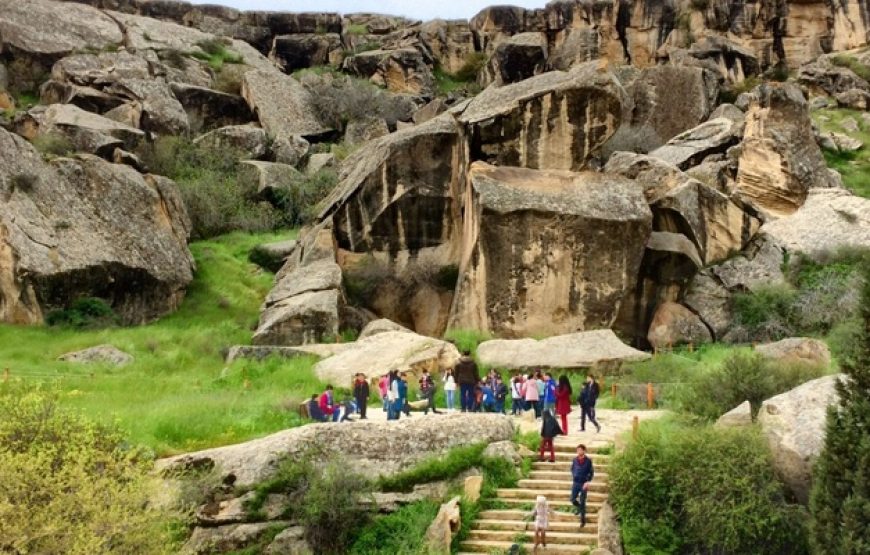
The landscape that greets you is ancient and stark: large boulders and rock faces scattered across a plateau above the Caspian, every surface worn smooth by millennia of wind and sun. And on those surfaces, carved into the stone by hands that existed long before writing was invented, are images.
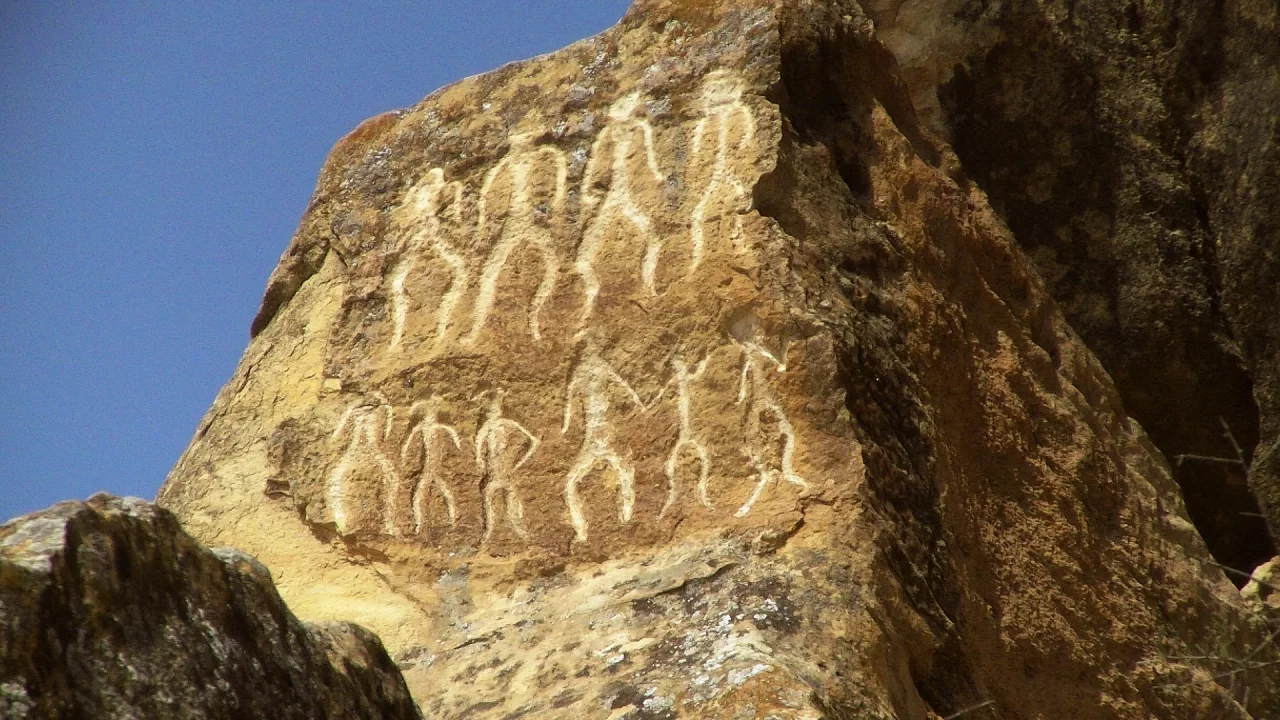
Hunting scenes. Animals that roamed this region before recorded history. Human figures — and this is the detail that stops people in their tracks — holding hands and dancing.
These carvings are considered among the earliest forms of human artistic expression anywhere on Earth. They predate the alphabet, predate organized religion as we know it, predate almost every structure humanity has ever built. They are, quite literally, the first written treasure of our species — made not with ink or clay tablets but with stone on stone, pressed into rock by people who wanted to record that they were here, that they lived, that they danced.
The Gaval Stone: The World's First Musical Instrument
Of all the remarkable things inside Gobustan, one stands apart — and most visitors walk past it without understanding what they are looking at.
The Gaval Daşı — the Gaval Stone — is a large flat rock that, when struck with an ordinary stone, produces a clear, resonant, drum-like sound. The name comes from the Azerbaijani word for a traditional frame drum. Historians believe this stone was used by the earliest inhabitants of this site as a percussion instrument — perhaps the oldest known musical instrument in human history.
We once brought a historian to Gobustan — a researcher who had spent years studying prehistoric cultures and had come to Azerbaijan almost by chance. When he reached the Gaval Stone, he picked up a small rock from the ground, looked at it for a moment, and began to strike the surface.
The sound rang out across the plateau.
He stood there for a long time, playing a rhythm, and then turned to the group and explained: "This is how the first human beings made music. This exact stone. This exact sound. What you are hearing right now is the oldest song in the world."
Nobody spoke for a while after that.
He then pointed to the nearby carvings of human figures — the ones that appear to show people holding hands in a line — and explained that these images almost certainly depict people dancing to exactly this sound. The music and the dance, recorded together in stone, in a place that has not fundamentally changed in ten thousand years.
The Norwegian Connection
One of the most extraordinary stories associated with Gobustan comes not from Azerbaijan but from Scandinavia.
A Norwegian traveler we hosted at Gobustan told us about a Norwegian writer and explorer who had visited the site and documented a striking observation: the rock carvings at Gobustan bear a remarkable resemblance to prehistoric carvings found in Norway. The imagery, the style, the subject matter — similar enough that the writer proposed a theory that the ancestors of some Norwegian peoples may have originated on the Absheron Peninsula and migrated northward through Europe over thousands of years.
The theory remains debated among historians. But standing at Gobustan and hearing it, looking at the carvings on the rock faces around you, it does not feel impossible. It feels like exactly the kind of connection that a place this old should have — threads running from these stones outward across continents and millennia, connecting people who never knew they were connected.
The Snake Warning: Stay on the Path
This is practical information that every visitor to Gobustan needs before they arrive.
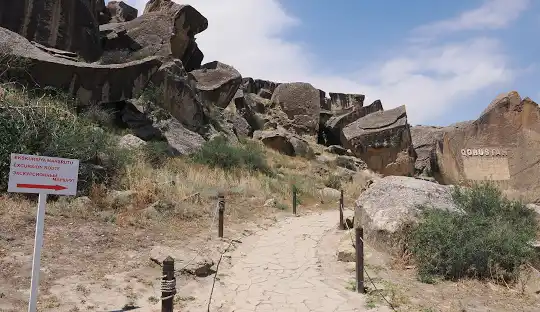
The reserve is natural habitat for snakes. The park management applies chemical treatments along the designated pathways to keep the snake population away from the visitor routes — meaning that as long as you stay on the marked trail, you are walking in a protected corridor.
The problem is that some visitors, wanting a better view or a closer look at a particular carving, leave the pathway and venture into the surrounding terrain. This is inadvisable for two reasons. First, you move outside the protected zone and into natural snake habitat. Second, the reserve management takes pathway compliance seriously — straying off-route creates problems with staff in addition to the wildlife risk.
The rule is simple: stay on the path. Everything worth seeing is accessible from the designated route. There is no view, no carving, and no photograph worth the alternative.
The Best View in Gobustan
At the far end of the open-air museum, turn right. Follow the trail up toward the larger rock formations on the hilltops.
From this elevated position, you will have an unobstructed panoramic view across the entire Gobustan plateau and out over the Caspian Sea. The scale of the landscape — the ancient stones in the foreground, the sea stretching to the horizon behind them — is one of those views that does not photograph as well as it looks in person, which is the best kind.
This is the spot to slow down, sit for a moment, and let the place settle around you.
Check also our article about Baku Old City Guide - https://www.luxline.az/en/blog/baku-old-city-icherisheher-complete-guide
Mud Volcanoes: Add Two Hours to Your Day
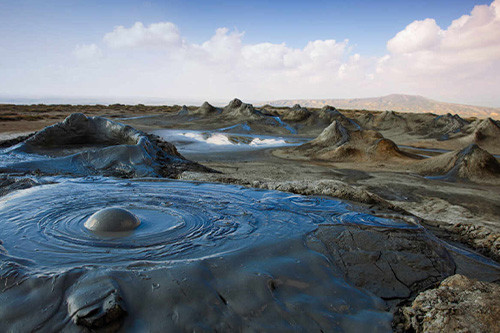
Approximately 12 kilometers from the main Gobustan site, the Absheron mud volcanoes are among the most surreal natural phenomena in the region — and one of the highest concentrations of mud volcanoes anywhere on Earth.
These are not dangerous. They are low-temperature geological formations — bubbling pools of grey mud pushed up from deep underground by natural gas pressure. The landscape around them is lunar and strange, completely unlike anything else in Azerbaijan.
If you leave Baku by 08:00 and move efficiently through the museum and open-air site, you will have time to visit the mud volcanoes before the afternoon heat peaks. Combine both into a single day trip and you will have covered two of the most genuinely unusual natural sites in the entire Caucasus region.
Note: The road to the mud volcanoes is unpaved and rough. A 4x4 vehicle is strongly recommended.
Book your Gobustan and Mud Volcanoes tour with us:
https://www.luxline.az/en/tours/experience-the-martian-landscapes-of-gobustan-the-mud-volcanoes
Where to Eat: Skip the Area, Stop at Bibiheybet
There are no restaurants near Gobustan that we can genuinely recommend. The options in the immediate vicinity do not match the quality a visitor deserves after a morning of serious exploring.
Instead, on your way back to Baku, stop at Bibiheybet — a small coastal village on the southern edge of the city, locally known as the Sanatorium area, sitting directly on the Caspian Sea.
This stretch of coastline is home to several of the best fish restaurants in the entire Baku region. Fresh Caspian fish, cooked simply and served with the sea directly in front of you. The combination of weather, food, and setting makes it one of those meals that becomes a travel memory rather than just lunch.
Three restaurants worth knowing: Shefa, Bülbül, and Dərya. Any of the three will serve you well. Choose based on availability and which terrace looks most appealing when you arrive.
While you are in Bibiheybet, consider a short walk through the village itself — it retains a quiet, old Baku character that the city center has largely lost. And if you have an interest in religious history, Bibiheybet Mosque is considered one of the holiest sites in Azerbaijan for Shia Muslims — a descendant of the Imams is buried here, and the mosque has been a place of pilgrimage for centuries.
Practical Information
Distance from Baku: 60 km, approximately 1 hour by car Best departure time: 08:00 – 09:00 AM maximum Entrance fee: Approximately 15 AZN per person (subject to change — verify on arrival) Time needed: 2 to 3 hours for the full site, longer if combining with mud volcanoes What to wear: Comfortable closed shoes — the terrain is uneven and rocky. Sunglasses and sunscreen are essential. Light, breathable clothing. Guides on site: Available at the museum. Worth engaging for the open-air section if you want deeper historical context. Snake safety: Stay on the designated pathway at all times. Mud volcanoes: Require a 4x4 vehicle. Add 1.5 to 2 hours to your day.
Getting There with Luxline
Luxline operates private day trips from Baku to Gobustan, with the option to combine the national park, mud volcanoes, and a Bibiheybet lunch stop into a single organized itinerary. Our drivers know the site, the timing, and the best approach for every type of traveler — whether you have two hours or a full day.
Book your Gobustan day trip with Luxline → https://www.luxline.az/en
You can also check out blog about the best transfer options in Baku airport - https://www.luxline.az/en/blog/discover-the-best-baku-airport-transfer-options-taxi-shuttle-bus-or-pre-booked-car-for-a-smooth-trip-from-heydar-aliyev-airport-to-city-center
Final Thoughts
Gobustan does not announce itself. It sits quietly on a plateau above the Caspian, waiting for the people who make the effort to find it.
When you get there, a historian might hand you a stone and ask you to listen. You will hear something that human beings have been hearing for ten thousand years. The dancers on the rock faces will make more sense than you expected. And somewhere in the back of your mind, you will start to wonder about Norway.
Leave Baku early. Stay on the path. Stop at Bibiheybet on the way back.
In addition, plan your 7 days holiday with us!
https://www.luxline.az/en/blog/how-to-plan-7-days-in-azerbaijan